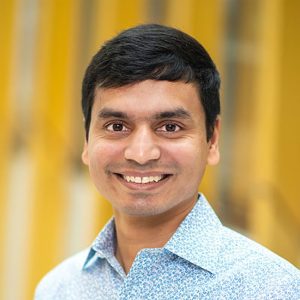
Today we have Prof Yugeesh Lankadeva on the show! Yugeesh is here to talk about his role as leader of the ‘Translational Cardiovascular and Renal Research Group’ as well as ‘Head of Systems Neuroscience Theme’ at the Florey Institute of Neuroscience and Mental Health.
He’s sharing how he grew his research profile to lead a basic science team that collaborates closely with clinicians.
Here’s what we talk about.
- The value of having many different mentors who offer different viewpoints.
- The importance of providing your team with some autonomy.
- The values of small grants for early career researchers.
- How to involve consumers in your research.
- The importance of investing in your self-development.
We also get into the value of doing an MBA as an academic researcher.
The Lead Candidate tool kit
- His researcher profile here.
- A great video of Yugeesh describing his research here
- LinkedIn profile here
- The book I mention “Be so good they can’t ignore you” by Cal Newport here
The Lead Candidate Web: TheLeadCandidate.com X/Twitter: @LeadCandidate Instagram: @theleadcandidate
Intro transcript
Hi, everyone. Welcome back to the lead candidate. I’m Dr, Simona Carbone. So on today’s show, we’re speaking with Professor Yugeesh Lankadeva. Yugeesh is a basic science researcher who collaborates strongly with clinical teams. He’s based at one of Australia’s leading research institutes for neuroscience research. Where he’s responsible for not only his own laboratory, but also a group of laboratories within the Institute to. So in this episode, we’ll get into how he manages to do all that, how he managed to reach this career position.
But we also touch on a few topics that are real passions for him as well, including mentorship. How important mentorship has been for his career progression? But also how he’s trying to teach others the importance of mentorship to. We also touch on why science communication has been such an important part of his story and why he values it so highly now. Enjoy this episode, Yugeesh has got [00:01:00] some great tips and examples from his career for us to learn lessons from.
Interview transcript
[00:00:00]
Simona: Welcome to the Lead Candidate. And today we are speaking with Professor Yugeesh Lankadeva
Yugeesh: thank you, Simona. Thanks for having me on your show.
Simona: Yeah. So welcome. So you have a range of roles. The two primary ones being that you lead the translational cardiovascular and renal research group.
And you’re also head of the systems neuroscience theme at the Florey Institute of Neuroscience and Mental Health. Before we get started and everything else, do you mind giving us a brief background of what these two groups are and the kind of teams that you’re leading?
Yugeesh: So the translational cardiovascular and renal research group that I’m leading comprises of four postdocs, four PhD students, two research assistants, and four technical offices.
And this group largely focuses on trying to elucidate the pathophysiology of brain and kidney injury arising from sepsis, which is severe infections heart [00:01:00] surgery requiring the heart lung machine and heart failure with the goal of developing a novel diagnostics and therapeutics to improve patient centered health outcomes.
The role as team head of systems neuroscience includes leading more like a group of research leaders within that team. That kind of dwells into understanding how the brain communicates with other vital organs via nerves. And this entails providing guidance and mentorship to up to 30 staff and students in a manner which it aligns with the strategic directions of the Florey Institute.
Simona: So across other institutes, I know the description of a theme can often be an equivalent word is like a department. So is it equivalent to a head of department or more like a cluster of research labs?
Yugeesh: Yeah, it’s more to do with a cluster of research labs that are working on like systems neuroscience, in some sense, like yeah, as I mentioned, basically looking at how the brain interacts with vital [00:02:00] organs in health and disease.
Which includes their, the heart, their gut, the kidneys, and all vital organs that I, that the brain plays an important role in.
Simona: Amazing. Now, I love your profile and the two groups that you’re involved with, because you can hear, Already the themes of how clinical engagement is so important.
So we will get into discussing how you engage with that clinical aspect of your work, and I’m sure the word translational comes up in your work as well. So we will get into that later on, but before we get started, I like to understand who we’re speaking with and how they developed their leadership style.
So we’ll go over a few things earlier on in your career and your development. And so we’ll start right at the beginning. So do you think you were born a leader or have you become one over the course of your career?
Yugeesh: I think definitely become one over the course of the career. As a, a teenager or growing up in school, I did [00:03:00] participate in a lot of sports activities.
Like I was an athlete, I played cricket. So went on to captain the under 15 and under 17 cricket teams in school. And I think in a lot of ways Those kind of things taught you team spirit and also working within a team and some leadership traits. I think in a lot of ways that can be transferred to a professional career.
It builds your confidence, helps you deal with other team members towards a common shared goal. I think in a lot of ways that was a good start, but definitely leadership in science was adaptive and it also required a lot of Learning from other mentors, like not one, but multiple mentors, and you think about it as a tribe of mentors in some ways where you take the good traits out of role models, leave the bad traits because no one’s perfect.
And then you kind of mold it into something that’s your own
Simona: I love that. And I’m going to ask you a question about mentorship because that seems to be something that’s quite important to you. But before I get to that mentorship question, I guess this really is connected to mentorship as [00:04:00] well.
You are a Sri Lankan immigrant and you have been involved in various activities to either encourage other Sri Lankan background, predominantly people at schools to foster their talents and things like that. I wonder how important do you think being a immigrant or particularly Sri Lankan immigrant has been in terms of what characteristics do you feel you’ve really held on to and have helped shaped who you are?
Yugeesh: I think coming from a place like Sri Lanka, it was really It taught me that not every place in this world has equal opportunities. And I think coming from a developing nation like Sri Lanka, it showed me the limits of what we were operating in, where there was a lot of rewards based on nepotism and really barriers to entry for a lot of people if they’re not from the right family background or from the right financial background.
And one of the most enlightening things that I found when I came to Australia was That in a lot of ways, there are barriers here, but in a lot of [00:05:00] ways, people are rewarded on the merit of their work. And there are a lot of opportunities here that people from developing nations don’t have. It was great for me to see that, and that’s why it fit in really well to the Australian culture.
And it gave me opportunities I wouldn’t have otherwise had in Sri Lanka. And a large part of giving back for me is to really encourage, students from culturally and linguistically diverse backgrounds to really not be afraid and really push their boundaries and come to, be, not be afraid to be bold and follow their dreams.
And I think in a lot of ways. A lot of the work that I’m doing outside of work is targeting those ethnic minorities and those students from developing nations to help them follow their dreams and yeah, get the careers that they want.
Simona: Amazing. I love it. That’s so good. And it’s is it necessarily just in science or is it outside of science as well?
Yugeesh: It’s outside of science as well. I do a lot of work with my Previous high school, which has like a garment sector and international sector. So mainly focusing on the garment school children because they are the ones with [00:06:00] limited Opportunities. I also have a sponsorship program where I support the school education of About four children from very rural villages that doesn’t have the financial backing For education.
Those are things I’m really passionate about and something I would like to grow in the coming years.
Simona: Amazing. You can hear it, you can hear the passion, and I can’t wait to see what you do in that space. It’s gonna be pretty cool. So mentorship we mentioned, can hear it. That’s a kind of mentorship.
It’s different in that it’s not specifically for a science career, but you also chair the mentoring committee at the Florey. And so it got me thinking about what mentorship looked like for you. You touched on sport and how seeing what, good leaders in sport look like and how that was a kind of mentorship.
What did good mentors look like for you in the development of your career?
Yugeesh: I guess the good mentors that I saw are the people that shine a light on the path and empowered you to do better and sometimes bigger than what they have achieved in their own careers.
[00:07:00] And sometimes as I mentioned, you got to identify mentors for their strengths and their weaknesses. And I think as humans, nobody is perfect. And I think everybody has their strengths and weaknesses. So that’s why I think it’s important to adapt various leadership traits from multiple mentors.
And I think in my career, I’ve been really lucky in some sense. I’ve had great academic mentors who are sometimes not so great at fostering career development. And I think finding mentors beyond your own academic realm that doesn’t have a conflict of interest. direct conflict of interest to what, your career is, was really great for me.
And that made a world of difference for me to progress my career forward. And I think having that mixture of mentors directly from the academic realms and also external mentors The combination of both I think is key and that’s part of the reason why I’ve been really passionate about chairing the Florey staff mentoring committee where, you know, I try my best to encourage people about the value of seeking external mentorship and [00:08:00] always try and couple them with mentors that kind of cater to what they want to achieve in the next four to five years.
Simona: Yeah, that’s super interesting. I was wondering about that if you were able to, because often with the structured mentoring schemes, it’s quite internal. And so yeah, hearing you say you’ve been trying to encourage people to look externally for mentors. Is it the kind of program where A mentor is assigned to a mentee, or is there some kind of, I don’t know, dating process or how does it work?
What does it look like?
Yugeesh: Yeah. We’ve trialed, I took on this role in 2018. I think we’ve trialed quite a few, including speed dating mentors. I think, various things worked. And I think, when we started, it was like 20 mentors and 20 mentees this year.
I’m really proud to say it’s gone to 120 now at the Institute. So there’s been a lot of people that’s taken it up, and I think a lot of this was like letting the mentors speak about not just their professional accolades, but their mentorship style in their bios, and then the mentees get a chance to list their top three mentors based on what they want to [00:09:00] achieve, and then we pair them up as best as we can, and then we check back with them in a timely period to see if the relationship is working out.
And if not, we make sure they find another mentor that kind of fits their purpose.
Simona: I love that. I really like that idea of having the mentor style as well. Because not all styles will fit for every other occasion or every person. It also got me thinking about, you’re mentioning how not all mentors are good for Every person or every aspect of a person’s development.
I also think life cycles as well of mentorship come, come and go. Sometimes you’ll speak to someone for a long time and then naturally you won’t necessarily need to ask them about things anymore. How have you in your personal mentor mentee relationships when you’ve been the mentee, how have you navigated that life cycle process do you think?
Yugeesh: I think it’s always good to go and meet your mentor with an agenda. I [00:10:00] think that’s one of the things that mentees sometimes don’t do is like they go to a meeting and they want to have a chat and the mentor really has to dig it out of them. And I think, in a lot of ways I always went to an agenda and I said, these were my short term goals.
These are my long term goals. How do you advise me to navigate through various crucibles to achieve this? And where can you point me towards the directions where you can’t help me with some of them? Where else can I seek help? And some mentors do that really well and the others don’t.
And I think the key is to recognize that here’s areas this mentor can help me with, and here are the areas that I need to seek other mentors for. So it’s better off being a little proactive about it. And that’s something that I’ve tried to bring into the program is like training on how to be a good mentor and how to be a good mentee as well.
Because you don’t want the mentor going there and talking about the doom and gloom of research and mentees going there and just going down to catch up for a coffee without an agenda. Yeah. Sometimes education on both fronts, I think helps have a very meaningful relationship.
Simona: Yeah, I [00:11:00] like that. It’s definitely true. You don’t want to be you don’t want to waste those sessions. But either person’s part, everyone’s time is really valuable. I will add though, sometimes as a mentee, you don’t actually know. You can’t pinpoint what it is that you need help with if you’re frustrated with something.
I don’t know if that’s something you’ve experienced personally or mentored someone on that, but you can’t quite pinpoint what it is that you need help with and just chatting through an issue with someone can be helpful too.
Yugeesh: No, absolutely. And I think it’s something that I learned. It’s sometimes it’s good to sit back and really listen without trying to jump in and offer a solution straight away, because sometimes the problem takes a while to emerge and it takes a while for their mentee to articulate it and also to make them feel psychologically safe to really talk about it because they don’t, one of the great things about having an external mentor is that you have that psychological safe to talk about things that you can otherwise talk about, but sometimes they take that time to really feel safe.
And I think it’s up to you as a mentor to really listen and give them that space to really open [00:12:00] up and then really dig it out of them if they, if it doesn’t come out easily.
Simona: That’s a really good point. Thank you for discussing that. It wasn’t planned mentorship, but I can hear how important it is for you.
So thank you. Another big part of your profile is engagement. Media engagement, but talking about your research in a way that’s really approachable so much so that it’s one of the parts of why you were awarded the Victorian Young Talk Poppy Science Award in 2023, which is pretty cool. How did you get into engagement initially and what were your initial motivations?
Yugeesh: It was something that I was really passionate about. And I think there was when I first came into the field, I inherently saw some limitations that I would like to address in my own career in the best way I could. And one of the, one of the aspects of that was not Keeping the public engaged in a manner in which that kind of caters to their ability to understand the complex nuances around science and really managing the expectations and [00:13:00] really keeping them informed about where the taxpayer dollars go and what we were, what the scientists and the medical professionals were doing with it.
And I think that, that really motivated me because Sometimes, being in, as a scientist, you’re in a field that you’re constantly, criticized constructively or otherwise. But when you talk to the public, you get this raw excitement about, the cool things that we do in our realms.
And if you can make them understand the really transfer that passion onto you and use meaning to what you do as well. So it becomes a really nice symbiotic relationship between you and your consumer, in some ways of your research and really assure them that the taxpayer dollars are going towards a good purpose.
And we are trying to change the world. And it also, the other aspect is really clinical engagement. Again, is another aspect that I really wanted to work on, but I guess we can touch on that. Later on.
Simona: Yeah. A bit later on. Yeah. Cause we are definitely specifically going to talk about clinical engagement.
But just thinking [00:14:00] about that in terms of speaking to the general public about your science, one of the things I found was that it actually helped in my ability to speak to other scientists as well about my research scientists who aren’t necessarily in my field of research. And then with industry and clinicians too, I can imagine you’ve had those sorts of benefits as well.
Yugeesh: Absolutely. And another thing I really wanted that really motivated me, Simona, it’s thank you for bringing that out. It was like, I really wanted to bring consumers into my research. And that’s something that was also a motivating factor. And, as a medical doctor, you probably would get more access to those kinds of patient groups, but as a scientist, sometimes you don’t.
And this is a really great way to reach out to people with direct lived experience, which I was really keen to engage with. And I think doing public talks really enhance that interaction between The indications that I was trying to work on with research and the people that were directly affected by it and bringing them on to the research program going forward has really been [00:15:00] such a great such a great asset to really informing what they really wanted.
And how we can solve their problems better.
Simona: Super interesting. We’ll just, we’ll dig into that a bit more. So consumer engagement. What does that look like? I know we’re going to talk about this in a minute, but we might as well jump to it now. Consumer engagement. What does that look like in your research area at the moment?
Who are you engaging with? How do you engage with them?
Yugeesh: Sure. Yeah, so basically getting people with, so with sepsis or, what I engage with up survivors of sepsis or their carers and really talking to them about what the experiences were. Most of them were it’s critical illness.
Some of them don’t remember going through the entire experience, but. What it was like to come out on the other side and live with the long term repercussions of critical illness and what their family members went through during that process and what could be improved in the medical system to make that experience better for future patients.
That’s been great because what we’ve got now is like a really nice group of consumers that come to our [00:16:00] retreats for research programs. They share the experience and we get them involved. In for designing some of the research directions, and most importantly, the input into patient information consent forms has been really invaluable because as scientists and doctors involved, the wordings that we use, sometimes we don’t even realize the words are not catered to the public and people with poor English literacy.
Having consumers involved has really changed the way we have designed patient information consent forms. And another thing that I’m really interested in is, again, Having representation to include patients from culturally and linguistically diverse backgrounds at clinical sites because if they don’t understand clinical translators, they won’t join clinical trials.
So it’s inequitable. So again, having, either translators or little information videos in various languages at those sites so they can actually understand what clinical trial that we’re trying to run so they can make an informed decision of whether they want to join that program. Or not
Simona: amazing.
I love it because you don’t think of that like you try to design a clinical trial in a way [00:17:00] that you do get a widespread demographic culturally linguistically different backgrounds. But if you’re not writing the consent form in the right way. You’re failing before you even start, right? That’s that’s brilliant.
I like that. And having written patient consent forms is probably smarter just to ask the patients what they understand and what they don’t, right? And cut out the guesswork in between. Brilliant. You mentioned your research retreats. I’m intrigued. What are they? What do they look like?
Yugeesh: I think the main, retreats that I have for the programs that are quite well developed and quite extensive at the moment is the sepsis program. In 2023, we were really fortunate to get a 4. 9 million grant from the medical research future fund to basically take a therapy to phase one B and phase two clinical trials across every state and territory in Australia, except for Tasmania.
We haven’t been able to recruit Tasmania yet. So Every year the scientists and clinicians, we organize a research retreat, which involves like all the scientists, clinicians, consumers, as well as the [00:18:00] nurses. And we plan the program of research ahead and the clinical trials ahead. We share discoveries and then we share our knowledge and then talk about our strategy to do this leaner, better and bigger.
It’s great. Last year was the first Megascores is the T, the name of the program. So that was held in Adelaide, which was fantastic. And one of the clinical colleagues wineries. So we actually call the students, scientists, clinicians, consumers, nurses, all together into one place and designed our, shared our knowledge and plan our research program for 2024.
And we plan to do that annually. And we have been trying to do the same thing with the heart surgery research program as well, which we kicked off this year with the team of clinicians and scientists and students involved in that as well.
Simona: Amazing. Okay. So these are all really big research programs that involve multiple sites, multiple labs within those sites and multiple groups in those sites as well.
But obviously you don’t just start from there. So we’ll take another step back again. You finished your PhD in 2013 [00:19:00] at Monash University before joining the Florey as a research fellow. And pretty quickly afterwards, you ended up leading a lab. Do you mind explaining what that pathway looked like for you?
Yugeesh: Oh, it didn’t feel quick. At the time, I can tell you that yeah. I joined the lab, which was around four or five people at the time. And the incumbent group head was thinking about the retirement his retirement within the next couple of years. So I had to quickly think about what my own career was going to look like very quickly.
It was an area of research that I was absolutely passionate about. It was sepsis. That’s where I started my career. A lot of ways it was challenging because it was a very complicated disease and a lot of my senior key opinion leaders at the time said, it’s where it’s a, it’s an indication where people and drugs go to die.
So you know, you’re going to have any future pick a different field was something I was constantly hearing, but it’s also an area of research I felt that could use the most amount of [00:20:00] help. And I felt like we could do that with the platforms that we had here at the Florey, which has, which is truly unique.
And the mentorship provided by my mentor at the time, Professor Clive May, was quite unparalleled. And I felt like there was a lot to learn there. And being at the center of Parkville next to a lot of adjoining medical research institutes and hospitals. I saw a lot of opportunity for collaboration because of the proximity based location.
Yeah, like look at the start, it was a lot of long hours. Quite isolated in the lab, but I was also very keen to spread my wings and start new collaborations and really bring other clinicians into the program and also other scientists eventually. And yeah, that’s where I started.
And I guess for the first four to five years, it was constant grant rejections one after another, which is really testing. But but the good thing as early career is there are those, Small opportunities like the early career research grants. And I think the university of Melbourne, [00:21:00] early career research grant was helped really helpful.
And the Jack Brokhoff foundation, young investigator medical grant was pivotal to me at the time, which kind of helped me do the momentum of bringing in my own funding and. driving my own research directions that then enabled me to get the Heart Foundation Early Career Fellowship, transition on the future to level one and then level two and very recently invest to get a grant.
So it wasn’t easy, but it was if you want something bad enough, I guess you’ll always find a way and you can find other like minded people to help you along the way.
Simona: Yep. Brilliant. So just a couple of things to firstly explain for our more international audiences Parkville in Melbourne is known as like the biomedical precinct.
It’s where there are a bunch of hospitals adult pediatric women’s health hospitals. There’s a cancer research institutes and care institutes as well. And. Many of the universities have locations in this site too. So it [00:22:00] is really the biomedical precinct of Melbourne. That’s why it’s such a great place to work in really good for collaboration between clinicians and basic scientists.
I really liked you mentioning how important the early career research grants were for your. Establishing establishing yourself. Because I think it’s like a good way of getting some runs on the board. Isn’t it like just using it’s a cricket pun, getting some runs on the board showing that you know how to write a grant, know how to pitch people, invest in you, you prove yourself.
And then the rest happens afterwards. People can come in and think, Oh, I’m You’ve just started and become successful straight away, but there’s a lot of building up momentum. Yeah. Is that a fair comment?
Yugeesh: Oh, no, absolutely right. Yeah. You need some runs in the board and a track record of managing your own projects.
And I think bringing in your own grants is a really good evidence based metric of you leading your own research directions. That’s what it gives you is that independence to really think about an idea and drive it yourself rather than being tied to somebody [00:23:00] else’s. Research program where they take the, ownership of that.
You can really drive your own ideas. game, really compelling pilot data and that track record support, support the bigger grant applications to NHMRC and make a research fund. So absolutely, yes, really encourage that for all early career researchers.
Simona: I think that’s such a good point that you just specifically mentioned.
It’s establishing You’re yourself independently showing that you have your own ideas, scientific, or again, can lead a project on your own. And I was wondering whether you really had a vision of what you wanted your research lab or research career to look like from quite an early stage, or was it something that kind of built with a bit of momentum and opportunities that presented themselves?
Like what did that look like for you?
Yugeesh: I intrinsically was driven by the motivation of kind of translating discovery science to clinical trials. That was always my motive when I started. For me, that’s what gave me the most [00:24:00] meaning to what I was doing was the, everything else like getting funding and accolades and the recognition is means to that end.
So it was really important for me to find a path where I can seamlessly translate discoveries made. from bench to bedside. And I think in a lot of ways, that’s why I started the engagement with clinicians quite early in my career, because I felt like if I got them to buy in early into the research program, co design it it’s easier to design a solution, not just a solution, but a solution that they can use for that indication.
And that’s something that really motivated me from the start.
Simona: So in terms of The way your research program has worked out. We’ll talk now a bit more about the clinical aspect. You, one thing that’s quite surprising is you don’t, you’re not medically trained, are you? You don’t have any medical training.
Yugeesh: Oh I did go to medical school at some point in my career, but I switched over to this side of the pond quite rapidly. Yeah. Yeah. I did an honors project and I was, I fell absolutely in love with research and decided to hang [00:25:00] around for a little bit longer, a little bit longer. PhD and Yeah.
Simona: And here you are. Because that is not very clear on your profile anywhere that you have had. Medical training, but it explains a lot actually, because it I assumed that you that you were medically trained based on the kind of research that you’ve been into and the way that you’ve engaged.
That’s a really interesting point. Now there’s a new question that I wasn’t expecting. Do you think then your experience in medical school has helped shape the way that you engage with clinicians now?
Yugeesh: It was a very brief time, it was enough for me to realize the complexities and the environment and the restrictive environment that clinicians work with.
So that kind of quickly helped me pivot towards this end and kind of thought, Hey, if scientists and clinicians start working more closely together. They could overcome these barriers and really move discoveries more from bench to bedside and understanding each other’s worlds was critical for that.
Simona: Yeah
, interesting. That makes a lot of sense. [00:26:00] So then what did you see as being or what do you see as being some of those deficiencies where it doesn’t go without naming names, but could you give an example of where those engagements don’t quite work out.
Yugeesh: Yeah. I think it starts with having no engagement at all.
And I think scientists not engaging with clinicians at all and reading a lot of papers, doing a review articles and figuring out their problem. And I think in a lot of ways in business, they always start with the question of what does our customer end user really want? And they don’t really think to ask that first before they come up with a solution.
And I think it’s really good to sometimes do that research on your own and really Go and talk to those clinicians for the indication that you’re treating and be part of their environment to really understand the restrictions they face and the restrictions of that particular environment.
Like for me, intensive care was the environment that I wanted to operate in. It was important for me to go there and see that environment in person and spend some time there with the clinicians. Talk to them, talk to the research nurses and the [00:27:00] nurses there, and then really bring those clinicians on board so we can actually co design the animal model and co design the experimental interventions.
That really fits that indication. So it’s not just a solution, it’s a solution that they can use within the restrictions of that environment.
Simona: That’s brilliant. Yeah, I love that. So just for the listeners in Australia, a lot of the particularly for national health and medical research funding that we get is moving more and more towards needing to have translation being a real central part of the research program.
But that doesn’t necessarily mean you have to have a clinician involved in the project or a consumer involved. However, it’s really evident that the ones that do it well, do have, That the consumer involved properly involved in the project and clinicians properly designed in designing the project as well.
How did it start those really first collaborations? Did you get an introduction or how do you recommend that a researcher get an introduction to the right kind of [00:28:00] clinician?
Yugeesh: I was a little bit lucky that my mentor at the time, Professor Kleinman, had a long standing relationship with a key opinion leader, Professor Rinaldo Bellomo, who was a key figure in intestinal care medicine.
Rinaldo was my first Clinical interaction to that space, but one of the great things about getting to know someone like Rinaldo is that he’s got extensive network of other clinicians and, Rinaldo and Clive, I think, they’re of a similar age, but I wanted to really engage with these, the next generation of clinicians that, that, you know and one of the things that came through Rinaldo was this really nice network of the younger clinicians as well as the older clinicians.
So it was like tapping into both those networks at the same time. It was great. We, we co designed a solution to develop a new biomarker of kidney injury. That’s where it all started. And it was great because it also, it entailed having a, a probe that was inserted to a bladder catheter that was already inserted in a patient with sepsis.
That’s where it first started with the clinical translation. And then it like it opened the door to collaborating [00:29:00] with clinicians of the next generation and really building a network there, which then enabled us to really expand into this really big national collaboration with other clinicians across the country.
So it started small started with one person, but then through that person, you can have access to other people, and you foster those relationships, you grow friendships and make shared goals and. Do a, do all of these really meaningful collaborations that give meaning to both our lives on, on each side of the spectrum, which has been absolutely it’s been an asset and it’s been really fulfilling.
Simona: I love that. You can hear it and you can see I can see the passion that you have for it too. It’s really interesting. You mentioned just starts with one small thing. So establishing a biomarker study really simple, but you wouldn’t have been able to have the idea of how you get your samples if it wasn’t for engaging with a clinician.
But I’m sure that whole project established trust between you, which led to the other introductions afterwards as well.
Yugeesh: Yeah. And I also, it also said the [00:30:00] precedence of Already established clinical translation of discovery science. So it helped make the case for other grant applications where you already got a history of translating something from batch to bedside.
So it’s like the same thing as a grant track record. If you already have a track record of clinical translation that also helps build momentum that you can do that in the future.
Simona: Yep. More runs on the board.
Yugeesh: Yes.
Simona: I love it. It was really interesting to hear you just at the top there describe using a business analogy and a good segue to mention that you’ve recently completed your master’s of business, your MBA.
So what made you do that? Why did you decide to do an MBA now? And how has it been beneficial to you so far?
Yugeesh: Oh, it’s changed my life and my career, to be honest. That was one of the best investments that I could ever make in myself. The reason I did that at a time that confused a lot of people.
I did that on the year that I got two NHMRC ideas grants and my fellowship renewed for four years. So it really confused [00:31:00] both my mentors and my Why did I pick to do an MBA then? The reason why I did it is because that was the other key segment that I wanted to tap into was industry. I wanted to really bridge the gap between clinicians, scientists and industry.
And I think if these three entities work closely together, and I think it’s vital so that they do you can not only translate things from bench to bedside, but eventually when you move up to phase one, phase two, phase three, you need industry partnerships to really make it available at a global scale to people all over the world.
And I think. In a lot of ways, I felt very early in my career that I wasn’t really trained to pitch to industry in a manner in which that resonated with them. The same thing that you would pitch to scientists or clinicians is not what businesses want to hear. They’re driven by other factors that, that motivates them.
And I wasn’t ready to talk that language. And I felt like I needed to learn. And a lot of people thought I was doing an MBA to leave science. And a lot of the scientists who were actually in the [00:32:00] course, were leaving So I’m not surprised, but I was doing it in a lot of ways to really bring that knowledge back into into academia and then also to develop my own leadership skills.
And I think a lot of ways leaders in our field, and I think in most fields are based or rewarded or they become leaders based on their performance. I don’t necessarily think that makes them good leaders. And I think leadership is something you need to learn and managing people, managing stakeholders. is something you need to learn and foster.
And it’s a continuous growth cycle. And doing an MBA and choosing the electives that really resonated with me was mainly based on learning those leadership styles and bringing that into academia as well as the business concepts. Back injecting me as well.
Simona: Amazing. So much to unpack. So well, the leadership start, we’ll start with that since you’ve basically described the premise of this show which is, you can become a great scientist and you get given a position of leadership based on your science, but that doesn’t make you a great leader of people.
What kind of [00:33:00] electives or can you give like some really poignant lessons that you got from those leadership electives that you chose?
Yugeesh: Actually one of the things that should resonate with your show, one of the, one of the the courses that I did was on authentic leadership and change.
And those are two units that I learned a lot from and it challenge, my own assumptions as the kind of leader that I want to become. And it really molded me into something that, that I’m really proud of. And I, I found that. Also, it was very different, going into the business world.
How do you motivate people? Usually it’s a financial incentive in academia that is really difficult to do. So how do you motivate people to give up discretionary time and effort without being able to financially motivate them or give them the level of financial security that other jobs in industry offers?
And I think I quickly learned it’s by giving people ownership and task significance and autonomy, which is. That’s why this job is the best job in the world is if you can give people those things and really push them to operate between their [00:34:00] limits of tolerance and limits of tolerance.
And what’s the other word? They had it written down and threshold for learning. So between the threshold for learning and limits of tolerance, I think it’s called the Heidfeld’s zone of disequilibrium. I think you can really. unlock new leadership potentials in people. And sometimes you don’t always get it right. Sometimes you turn up the heat too much and that’s when you need to read the emotional cues and back off. But I found in a lot of ways at the early parts of my career, I was jumping in and, trying to solve, adaptive problems by thinking that they’re technical ones.
And I think you’re not going to make your people grow under you. If you keep doing that, and I think it was important for me to understand that you need to turn up the heat sometimes a little bit, but not too much. And really give them that task significance autonomy to really make it their own and make them feel like they’re part of the family.
Depending on whether they’re a technician, a research assistant, a scientist, or a clinician, you’re all part of this journey. And we are, everybody’s important to do what we’re trying to do here, which is to, help people’s lives.
Simona: [00:35:00] Yeah. Amazing. I love that. I, yeah, there was a lot of nodding in agreement on my end.
I’m listening to the audio book called Be so good they can’t ignore you. And I’ve just gone over the part about how important autonomy is for that feeling of job satisfaction that people want. And. Like you say, in science, there’s a lot of you, you can’t financially reward people or give them the stability, certainly not in the Australian landscape in academic research you can’t give them the stability that they might like, but autonomy is super important for them feeling satisfied.
And I imagine. Knowing that the research that they’re doing is having a translational impact would be super motivating as well. So the kinds of projects you’re involved in would definitely help too, for sure. That’s great. I love it. Just wondering what about from a business aspect, have you found yourself in engaging with someone or talking to someone specifically, can you cite an example where you’ve gone, Oh, I’m really glad I learned X from the MBA that I did.[00:36:00]
Yugeesh: No, absolutely. And I think one of the things is like really cater your pitch to your target audience. I think that’s something that really came out during the MBA and you get put into these syndicate groups of people from different backgrounds, like science from engineering to corporate law to investment banking to science, if you’re lucky.
And you’re expected to come up with this group project that’s worth 40%. And then at the end, it’s like a survivor game where the people will vote on how good you were as a team member. That was Yeah, that was very interesting. And I think that taught me a lot dealing with people from various backgrounds, with various personalities in one group for a semester, where that’s worth like almost half your mark.
And then they vote on how good you were as a team member. That was really enlightening and that taught you to yeah, really work with very diverse groups of people and really adjust your communication style. Wow. Very different people. And every unit in the MBA at the Melbourne Business School was like that.
It was amazing.
Simona: Wow. Super. [00:37:00] I imagine humbling as well, right? Very humbling experience at times too.
Yugeesh: A hundred percent . . Simona: I love it. Okay. The final part of this podcast is that I ask everyone the same questions to finish up. So the first of my closing questions is who do you learn the most from, or who have you learned the most from about leadership?