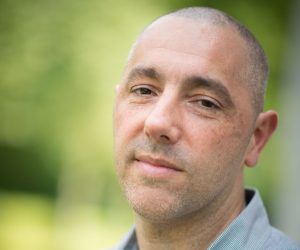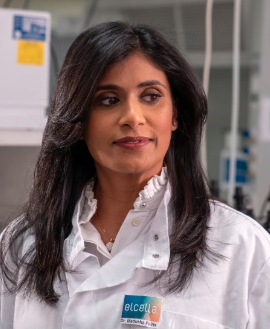
Today we have Dr Madusha Peiris on the show! Madusha is here to talk about her roles as CEO of biotech company Elcella, and senior lecturer and group leader at Queen Mary University of London.
She’s sharing her stories of how Elcella developed over the past 10 years- starting as a basic science project from her academic research through to a product helping patients with weight management. If you’re interested in how a scientific idea can lead to a company this episode is for you.
Here’s what we talk about.
- How she’s an accidental leader and entrepreneur
- The value of being flexible and adaptable when building a company
- What alternative academic pathways can look like
- The importance of universities valuing real world impact, not just paper publications
- Why a founding scientist can be a company CEO
We also get into how she’s never had a career plan- she went with the flow to see where it led.
The Lead Candidate tool kit
- Elcella’s webpage here
- Madusha’s university profile page here
- An articles that inspired content here
- Madusha’s Tik Tok profile here
- LinkedIn profile here
The Lead Candidate
Web: TheLeadCandidate.com Twitter: @LeadCandidate Instagram: @theleadcandidate
Episode transcript
Simona Carbone: [00:00:00] I acknowledge that I made this recording on the lands of the Wurundjeri people of the Kulin nation. I pay my respects to their elders past and present. These elders lead by nurturing the physical, spiritual, mental, and emotional wellbeing of the communities they serve.
Welcome to The Lead Candidate, the show where we aim to understand what makes for a great leader in science. I’m your host, Dr. Simona Carbone.
I have a quick question to ask you. Would you like me to come and speak at your workplace? I give talks on leadership in science, moving from academia to industry, and even the latest in gut science and the best bit. Every speaking fee helps keep the Lead Candidate going so we can share more stories together.
If that sounds like something your organization would love, then reach out to me on LinkedIn. I’d love to hear from you. Now onto our next guest.
Dr. Madusha Peiris is [00:01:00] founder and CEO. Her product, Elcella is a food supplement and weight management solution. The workup for Elcella comes from Madusha’s academic research and alongside her co-founder Dr. Ruby Ackta, they’ve developed this project together. Madusha is currently on sabbatical from her role as senior lecturer and group leader at Queen Mary University of London. Madusha’s passion and excitement and purpose all really shine through. I think she presents an excellent case for when an academic researcher really is the right person to lead a company.
So enjoy our chat.
Madusha is all the way in London, uh, but an Australian by background in terms of certainly your PhD training. Were you born in Australia or were you, were your family from
Madusha Peiris: No, yeah.
No, I was born in Sri Lanka. Um, we moved over when I was about six, seven, and I. Gone to school in Australia the whole way through, right up until I finished my PhD.
Simona Carbone: Beautiful. So real international in terms of where you’ve [00:02:00] lived and the things that you’ve done. Uh, so we’ve got you on the lead candidate today because of your role leading Elcella, uh, CEO, uh, and also from your academic training as well, and your academic leadership too.
So you bring a nice mix of biotech leadership and academic leadership. Uh, so just a bit about your company. Uh, could you explain to us what it is that Elcella are trying to do and, um, what product it is that you’re making?
Madusha Peiris: So Elcella is a disruptor to the weight loss market. Uh, our product is a revolutionary new approach to, uh, supporting weight loss through gut hormones, which we now know are the key drivers of appetite regulation.
Um, by harnessing the power of your gut, specifically the L cells, that’s where the name Elcella comes from, uh, to scientists. L cells are, you know, pretty special, but we, I’m trying to make L cells. Well known throughout the world as the key arbitraries of appetite control because they store and [00:03:00] release these very potent appetite controlling or appetite reducing hormones.
Um, and so Elcella is a product that is all natural. It, uh, targets due protein, copper receptors using natural agonists, uh, which are nutrients. Um, and it’s a twice daily oral capsule that you take, um, over a course of at least 12 weeks to really see a shift in weight and shift in appetite and cravings and energy levels and all that stuff that comes with it.
Um, but yes, very much a different way of approaching weight management in an um. From an aspect of getting back control from, from an aspect of giving back control to you back to your body and not creating a dependency on drugs, on injectables, um, and looking at it from a natural perspective of let’s resolve the problem rather than put a bandaid over it.
Simona Carbone: What I love about the way you have developed this [00:04:00] product is that this has been a course of, of 10 years of your academic research, but it very much comes from of trying to understand the physiology. You’re a gut scientist by training. I’m also in enteric neuroscience. So for those who don’t know, your gut has its own nervous system.
Its own little brain. That’s the controller of, of its most of its functions. The big brain in your head, uh, generally can regulate things, but it’s that little gut brain that controls things really at the. At the tissue level. Um, so you’ve come from that physiology under trying to understand the system and you’ve managed to develop a product to treat people.
It’s not necessarily, you know, uh, it’s not a therapy as such, but it’s something to help people with weight management. So I love that from, it just shows the importance of why studying physiology is so valuable. Right. Um, did you ever expect or aim to be developing a product to help people or was it more an interest level thing that then became something else?[00:05:00]
Madusha Peiris: I was always interested in the translational aspect of science, of trying to translate what we found in the lab and actually getting it across that translational gap into clinical trials, showing clinical efficacy, and then actually making it a product that people could use. So my view from the time I was very much a junior scientist was that I want to use my time to not just research things that I find interesting, but research things that I find interesting and will have an impact on people.
So that was always my mindset from the get go. Now what, uh, when it comes to actually making a discovery, I don’t think any scientist goes in to the lab and does 10 years worth of experiments thinking I’m gonna make something that is going to, you know, change people’s lives. You, you simply go in there, as you know, simona you every day asking a question, hoping to get a, a great answer.
Probably faced with lots of. Different questions that come back at you. Some of them are not helpful. Um, [00:06:00] and optimizing. And optimizing constantly, so. It was very much as you said, trying to understand the fundamentals of gut physiology. Think thinking that we have these answers already, but actually we didn’t, we didn’t know at a, at a very molecular level how dietary nutrients interact very closely with your gut at the very epithelial or superficial level.
Um, and we took it for granted that what you eat just gets absorbed and that’s that. But it was much deeper than that. And what was really cool for us, and we didn’t realize it at the time, was that the type of work we were doing was so novel, uh, which all science generally is, but it was fitting alongside what we were starting to understand about appetite being highly regulated by gut hormones.
And it wasn’t just in your head, it wasn’t just a psychology, it wasn’t just willpower and that. It’s still something actually the public really need to understand and need to learn. And I really want that to [00:07:00] happen because it’s so much about what your gut does and the health of your gut that can determine so many things.
And in this case, appetite. So short answer is what we weren’t looking for it. We were, I’m trying to understand the fundamentals, but from my perspective, trying to get a product that could help people was always part of my remit as a scientist.
Simona Carbone: I love that. That’s, um, yeah, it’s really cool because it shows how you can take your passion, be patient, and you never know where it might take you.
Okay. So one of the first questions I ask people right at the start, at the top of the interview, uh, given this is a podcast about leadership in science, do you think you were born a leader or have you become one over the course of your career?
Madusha Peiris: Um, maybe I was born a leader from the perspective of being the eldest in my family.
I, I have a younger sister, so I guess I was like born to the be that I had to be bossy for, from that perspective. And I have lots, I have [00:08:00] younger cousins who I could boss around, so I think I had some good training. Um, but no, I don’t think inherently, I am not an, not an intro, uh, extroverted person. I’m more of a, i, I, that’s why I liked to be a scientist because I could quietly do my own research and spend quite a lot of time.
You, you know how it is in the lab, often by yourself looking down a microscope or, or do like doing electrophysiology, which is very much a singular thing. Um. So, yeah, I, I don’t really necessarily think I was planning on being that person, but it just happened to be the case. Um, so I think it was an accidental thing.
Simona Carbone: I love that. When, when we were first emailing, you said that you were an accidental leader, and as I was reading more articles about you, you also said you were an accidental entrepreneur. So if those things were very much by accident, I mean, you kind of touched on what were your drivers for staying in science, but what did you see yourself becoming when you were a much younger Madusha.
Madusha Peiris: Um, [00:09:00] when I was a junior scientist, I didn’t really think too far ahead in the future, and I know that’s like very much like not what people do, people like make five year plans and 10 year plans, and I was not that person. Um, and what I think was beneficial that I did was I just focused on the present moment.
I focused really hard on just whatever I was doing. And I’m still that way even now. Of course we have to make plans to grow the company, this, that and the other, but I’m still very much like focused on what I do as I’m doing it in the present moment. So I think there’s a lot to be learned from that.
I think there’s a lot that we can obtain from just being present and putting the effort in then and there rather than thinking, well, if I do this and I can get to this, this, and this, I, I, I just don’t really think that’s the case, um, in, in, in many things. So it wasn’t the case for me. Um, I wasn’t a planner.
I wasn’t thinking, oh, I’m gonna be X or y. I was simply thinking, [00:10:00] I’m really glad and grateful that I can do what I love every day and be passionate about what I do. And that passion is really what I think has, um, helped me to get to where I am today. It’s just being able to be true to who I am, following my passion, focusing on the day to day, and not thinking too much about the bigger picture all the time.
Simona Carbone: Yeah, I love that. And you can hear it, you can hear the passion in your voice as you’re explaining it, and listeners can’t appreciate, but you can see it on your face as well that you definitely still get that excitement from what you’re doing, which is awesome. And there definitely is something in the idea of just being able to take opportunities as they come and seeing where things take you.
Um, that’s how my career has kind of panned out. I have had some wonderful opportunities just by taking them. So yeah, for people who feel like they don’t know where it is that they’re going for sure, it’s okay. You can actually have a really amazing career just by seeing where the world takes you. [00:11:00] Right?
Madusha Peiris: Absolutely. I couldn’t echo that any better than you just said. And taking opportunities and taking risks is, it’s scary. It’s scary and, and I think there are lots of people who prefer to plan ahead and think, okay, I’m gonna be doing this and then I’m gonna achieve this and this and that. And. Honestly, life doesn’t go that way and and hard as that is to admit.
It just doesn’t go the way you want sometimes and, and sometimes you can feel like you are stagnating and other people are, you know, leaping ahead of you and doing so much better. And, you know, you can feel quite bad about yourself at times. And. Gosh, I have been there, I have felt that way numerous times in numerous ways.
But you know, you draw yourself back to that mantra that you have, hopefully, that we all have, which is, I run my own race, I live my own life. And it’s easy to figure that it’s, you know, part of life to, to feel drawn, uh, in different directions because, oh my God, maybe I should be doing this, this person’s winning and I’m not.
Um, so it’s, it’s tricky. It’s not [00:12:00] easy to stay true to your own course, but I think it just requires patience and dedication and belief in yourself that you know what I’m doing, what’s right for me, I’m doing what feels right for me. Um, and hopefully, and I always say this to students, I, I promise you the effort you fit in today, instead of thinking about where it’s gonna be in five years, I just put the effort in today.
And I assure you that day in, day out, that effort, it, it multiplies. And at a point it becomes exponential and you’ll, you’ll see that. You just have to trust it. Trust the process.
Simona Carbone: Yeah, that’s really good advice. I love that. I love that for your students and now for people who’ve listened to this too, so that’s awesome.
Um, so just on that idea of seeing where life takes you, then that might explain perhaps, uh, one of your big moves, which was after completing your PhD in, uh, the University of Queensland, you then moved to London to join, uh, the Neuro Gastroenterology group . Uh, so there’s two moves that you did there.
’cause not only did you [00:13:00] move countries, you also moved fields of research ’cause you’re in, uh, the CNS central nervous system and you’ve moved to the enteric nervous system. So for some people that might sound like it’s just nuance, but that’s actually quite a big leap. Um, a big difference in terms of people who know you a difference in terms of the kind of science and techniques you do and things like that.
Uh, so what was the driver behind making those two, two big jumps at the same time?
Madusha Peiris: Um, probably youthful foolishness. That’s just for putting it pretty simply, youthful foolishness. Not knowing at all what I was getting into, not even understanding the fact that I was going from a completely different nervous system to another that, you know, fundamentally is similar but quite different.
No idea. I don’t even know how I got the job actually in, I can say now amongst friends, I’m really not sure. I must have said something that convinced, [00:14:00] uh, you know, uh, the professors that. Maybe she can learn it. Um, but yeah, and procrastination. That was the other thing. So I, it was, you know, like all PhD students, there comes a point, come maybe many points, then you’re, you, you know, you have to procrastinate a little bit.
It’s part of the journey. I was, um, about to go into the writing stage. I was like, oh my God, this feels like a mountain to climb. How do I distract myself? Uh, I thought, well, you know. Having a PhD is, uh, a passport to travel. You can kind of do a job wherever you really can find a lab or a group that you wanna work with, hopefully.
Um, and so that was a key driver, like, okay, uh, I wanna move, I wanna live somewhere different. And, um, that was a key thing when I think when you’re young, you wanna travel and you wanna explore the world. So that was definitely just one of them procrastinating, so I don’t have to write up quickly. Um, but it happened so that, um, I applied [00:15:00] for this job.
I got it. I was very surprised and it, I had, I had to write up and I had to hand it in. So that was a good, um, um, yeah, a good push if you will. Um, and yeah, I, I, I think it was just down to those things of wanting to travel, see what the world. Could bring. And you know, in Australian, the Australian culture around postdocs is you should travel, you should go outta the country, you should learn different techniques, get experience in different labs around the world.
And I, I certainly, you know, felt that that was a good way to go about it. Um, and a two year plan to come and stay and learn and do all that stuff, turn into, gosh, I don’t know, 17 year plan. So that’s one of those indications that you shouldn’t make a plan and, and, and, you know, be worried about it. Just see how it goes.
Yeah. So yeah, my story is very much along the lines of. Just give something a go. Don’t be afraid to make a jump, uh, if people believe in you. And really, what, what [00:16:00] really matters is your, uh, ability to adapt and your ability to say, you know what? I wanna, I’m gonna do this. I’m gonna give it a go, and then people will believe in you.
You know, that’s, that’s really what it says. So I always say to, uh, students, students get a lot of lectures from me, I guess, that don’t stress about the project that you do as a PhD student. You know, make sure it’s something you’re interested in. Make sure, most importantly, you’re working with people that you actually really get along with because you end up spending more time, you know, in the lab and working with people than really, like a project is a project.
So, you know, that was, that’s, that’s how I felt is that the project was a project I learned so much. I worked with some really great people. Um, but I, it also made me capable of learning so many other things that are in and around the same subject ish. It’s not really, um, but you can adapt, you can change.
That’s, that’s a fantastic thing. Those are the fantastic tools you get from being a PhD student. [00:17:00] The capacity to learn, adapt, and really start honing your skills in many different ways. I love that. Um, just you briefly mentioned that whole push that Australian universities or academics have for their PhD students, which is go work overseas.
Simona Carbone: Uh, that is very much a thing. That, that even now we still try to encourage a lot of our students. So I was wondering, is there something in the leadership style, perhaps in an academic environment that’s different between an Australian university versus a or you can comment on, um, universities in London.
Uh, is there anything innately different about the two or are they the similar, they’re more of the same. Should we be taking, you know, getting some confidence in, in the way that we’re running our groups and things in Australia?
Madusha Peiris: Um, I, I, well obviously I’m very biased. Um, I feel that the Australian tertiary education system is, you know, really, really fantastic because [00:18:00] we give students a tough time.
You know, it is not an easy ride. Um, we get challenged. We, we really get taught how to do things in a very, uh, particular way, which is very driven towards, um, attention to detail and perfection, and learning how to speak clearly and properly and being unafraid of, you know, getting. Some very strong feedback from, you know, our, our peers and, and from our superiors, uh, uh, supervisors.
Um, and I think that’s a good thing. I think that’s a really, really good thing. Um, I’ve seen lot, many Australians from different walks of life who have, you know, gone to top tier universities in Australia, do extremely well outside of Australia because we have a real can-do attitude. And I think that’s even come from my, when I went to school, I was a really shy kid and my parents were not having that.
And the schools were not having, not having that. And, you know, we got, I got particularly pushed to, you know, do things and I was like, oh my God, I don’t want [00:19:00] to, it’s like, no, no, you’re gonna, you’re gonna play the flute in front of all the people. You’re going to do the piano. I was like, shaking and going to eisteddfod.
I like, I don’t wanna do this sort of thing, but you know, you get. You get encouraged to do it and your teachers are really pushing you to do those things. And at the time you look back and you think, oh my God, I was so nervous. But those are the types of opportunities and training that really helps to, uh, learn how to articulate, learn how to speak clearly in public settings.
And I think generally help you become a better person and better leader because you become confident yourself and you also learn that, you know what, we all just need a bit of a support system. So, no, I, I think the Australian system is, is really fantastic for that. The UK in general, they don’t really push people to try and go overseas or do that sort of overseas training as such, even though there’s lots of opportunity to do so.
Um, I, I think it’s just a different way of, it’s a different personality set here. People [00:20:00] are a little bit more reserved and a little bit perhaps, you know, quieter, which is one of the reasons I actually moved as well because I didn’t necessarily fit very well with the Australian culture of, of. You know, being, um, I don’t know.
I wasn’t, I didn’t like to being at the forefront of things. I say that now
Simona Carbone: She says as a CEO.
Madusha Peiris: Exactly. I know. Uh, I don’t, I really don’t. Uh, it was not my intention, but I, I do think that for me, and I think for everybody, it’s really important to find where you fit best. Um, and for me it was just the, the UK culture really fit me really well because I could still be quiet, be myself, do my quiet work, and, you know, that was okay.
Um, and that was good enough. Um, and so, yeah, it’s just different personalities and what, what works best. But yeah, for me, I can’t, I can’t praise the Australian system enough for, uh, supporting me to become who I am today.
Simona Carbone: I love that. Um, so you’ve gone from being a postdoc and then lecturer, senior [00:21:00] lecturer, lab head, all within the same university.
What was that process like for you? Was it difficult at all being in the same institute where you’ve really developed yourself? Professionally making your mark, is that hard to try to find your space or was it, did you have support and mentors around you? What was that like?
Madusha Peiris: It wasn’t easy at the beginning, and I think that’s because, you know, I started working on, um, a very exciting novel technique, which by the way, I had no idea how to do from the day, day zero.
So I had to learn all of that stuff. Um, but it became like a very exciting outcome. And then it became like something that could be used quite heavily in pharma, you know, in in, in trying to do the translational piece in a better way. Um, so I had to pivot basically because there was too many people wanting to all do the same thing and there wasn’t enough space, even though that was, I, I, I really started it, that, you know, just be, I was so junior that I couldn’t really voice.
You know, [00:22:00] my actual desire to be like, can I, can I not be the leader? Hello. Um, and obviously being also a young female, it was, it was, it could be, it can be tricky, um, in, in certain scientific fields. Um, so I had to pivot away from that. But that pivoting is what brought me to appetite regulation, understanding how nutrients worked and all of this stuff that’s brought me all the way to Elcella.
So even though there are tricky bits in what I’ve had to go through, um, being able to be flexible and adaptable, um, and pivot away into something else, and then making that my own, um, because that’s what I do. I put all my effort into what I am doing at that time. Um, it wiped out. So there can be tricks and trips along the way if you let it happen .
I don’t think anyone’s immune to that. I think we’re all going to have to deal with that some point. Um. But yeah, just I think staying positive, seeing [00:23:00] that there are opportunities when they come along and taking them, like you say, um, and, and running with them is, is really what helps in the end, in terms of staying in the same place.
I actually think it’s been quite useful for me because I’ve been able to, um, build my research. Um, in, , in a natural way, I would say, rather than having to say, oh, I did that, done this project. I learned these fantastic skill skills and I got these amazing papers, and then I’m gonna go to another lab that’s also gonna help me do these amazing things and get amazing papers.
There’s lots of different pathways. There’s not simply one that is perfect for everybody. Um, this worked out for me. Um, it it, and it had to be that way because some of the research I was doing, it really took five to seven years to get in order to get a paper. Um, but, you know, that’s how it is. Um, and, and then the other thing is sometimes some people, and I used to feel really bad about myself.
Some people, like, you know, I have colleagues and friends who used to publish so many papers and do so many amazing things. I’m like, oh my gosh. And I’m still [00:24:00] working on this one paper that’s taking a long time to get to. But at the same time, we were sequestered with our data because of intellectual property.
And, you know, I was like, yeah, but still, you know, I, I just feel bad about myself. But, you know, we all run our own race and. At the end, you just, it’s so hard to do the bigger picture. You, it’s, it, it really is. But it’s just about, I think, staying true to the course of yourself. So there is no right or wrong way.
Is is the bottom line. Um, for me, this is the right way, but you know, it just happened to be that way.
Simona Carbone: I, I, I love that. I hear a lot in what you’re saying. I think first off, that whole idea of when you feel like something like you should be leading something when you’re ready to, but you are younger and it doesn’t quite work out that way.
That can be a really frustrating thing that a lot of us go through. Trying to find where your, your spot is in the field. That’s definitely something that a lot of us can have grappled with, I’m sure. Um, but then hearing you say about how [00:25:00] pivoting away actually led to something that was really amazing and unexpected is so important.
Um, you know, sometimes when, when I’ll talk to early career researchers about. The difficulties that I’ve had and, uh, over the course of my career, but the things that I’ve done as a result, some will miss the point and will ask, what would you have done to avoid it or to stop it from happening? And it was like, no, no.
That is the whole point. The whole point is that the difficult thing happened and it led to something that was awesome. So it is, I think that’s really important point to make. The third, uh, thing that I want to bring up was you just mentioned about, uh, limited ability to publish because of intellectual property reasons.
And something that I was reflecting, looking at your profile is that you are developing or have what would be considered more and more this term of an, uh, alternative academic career pathway. I know it’s something that at my institute we’re [00:26:00] trying to understand what that looks like and some universities are much better at embracing that than others.
Some of the, um, more established universities that have really held onto the idea of publish, publish, publish and nature science, cell those sorts of big journals. Um, and so for those of us trying to figure out where these alternative academic career pathway fits, how have you found that process for yourself and what support have you had and what things do you think you’ll be leaning into as you continue to develop this profile?
Madusha Peiris: I think one word that’s very important for universities, and I know it’s important for our university, is impact, right? And it’s not about impact factors, right? It’s actually impact. So what does impact mean? And that can mean lots of different things, but, um. From my perspective and the university that I work with, uh, at Queen Mary, like our feeling about impact [00:27:00] is, um, making an impact on the community, uh, making an impact on the economy, making an impact to people’s lives.
And so as researchers, what we should be doing is exactly that, right? We, we get funded, hopefully sometimes by the government. It’s very tricky to get that, um, by charities, you know, by, by people put pulling money together to help other people get better research outcomes, you know, get better health outcomes.
So impact. Is the key thing. And I don’t, and to think of impact just as impact factors is, is far too narrow. And I think actually really old fashioned and also impact factors are so, you know, controversial at the end of the day. Right? There isn’t a simple metric. Um, so for us and for myself and I work with the university, we’re so keen to drive impact.
Um, and that really is being able to get out of the lab. [00:28:00] Uh, and that could be if in engineering, that may be algorithms, software development, um, in, in biological sciences it could be, you know, licensing, um, a technology or technique even. And even from my very early part of my career, I was really very much on a translational trajectory based on the type of project that I started fast working on.
We were always thinking, well, how can we use this to, um, um, fasten the pace of development of something, you know, pharmaceutical or whatever. Uh, and I think that’s how it should be seen, and I think universities should and are now embracing the fact that, how, how do you actually draw further money in from, you know, and, and get that credibility around the world.
Well, actually delivering impact is, is the way forward. Um, and so from, from my own perspective and working with the university, it’s about. Getting this product out on the market, it’s showing that it’s come from, you know, dedicated years and years of research. We have intellectual property that’s [00:29:00] impact, right?
Um, we have patterns. We have a global imprint that we’ve, you know, made a revolutionary step change in how we think about and, um, support weight management. That’s impact how I go about it. And my co-founder, Ruby Aktar, Dr. Ruby Aktar, goes about it, you know, communicating about STEM, women in stem, uh, minorities in stem, uh, being representing you, uh, underrepresented communities in the entrepreneurial sphere.
All of that is impact. It’s, it’s very important to stop thinking about academic careers as just, uh, you just publish, publish papers and then, you know, you do what you need to do with the university to get your ranking, you know, senior lecturer, blah, blah, blah, blah, blah, up and up until you’ve reached some pinnacle.
It’s, it’s narrow and I think it’s old fashioned, and we need to start broadening how we approach what we do as scientists is driving impact in a really public way.
Simona Carbone: [00:30:00] Here, here I, um, agree with so much of what you just said, and you hit about four topics that I wanted to cover. So now I’ve gotta try to go back and remember which one I wanted to talk about first.
Um, well, one of the things that I wanted to ask you about is, uh, so obviously you, you lecture, uh, given that is one of your roles, but you’re currently on sabbatical. But since taking a sabbatical, you’ve actually ended up going on TikTok and now it seems like you are teaching people, though you’re very clever, uh, TikTok handle, which is, uh, what is it?
At Mad Gut Scientist, is that correct? That’s, that’s the gut scientist, MAD’s the gut scientist. There we go. Um, which is just brilliant. Um, so, and within that you’re communicating to the general public. You’ll get people to ask you questions and I love that. So the first part of about four questions to stem from what you just said, uh, is how do you, how do you go about communicating to the general public versus lecturing, uh, to students?
Are there similarities? Are there differences? Can you [00:31:00] cite something that’s useful in both situations?
Madusha Peiris: Yeah, so the common thread is to keep people interested by keeping it simple. Uh, I keep it, I really like simplified messaging, easy to understand wording, um, and very. Simple overall, um, outlooks on, on how we communicate with anybody, literally anyone.
Uh, and I, I know I’ve listened to lots of different people lecture from various, you know, levels of academic seniority to. People in business, et cetera, et cetera. And there’s always a common thread, like the most engaging person I listen to is somebody who’s actually talking to me in a way that is understandable from minute one to minute 30.
They’re just keeping me engaged because you know what everything they’re saying is something I can understand and digest. Haha, as a gut scientist. Uh, you know, all of those things are really, really important and I think that’s [00:32:00] what I always try to do, no matter whether I’m lecturing medical students or, you know, making a TikTok and talking about it, um, just to the general public.
And there’s, I’m doing a lot more of interfacing with the general public than I ever have before. But, you know, whenever you’re writing grant applications and you’d have to write that lay summary, and I used to really struggle like, oh my goodness, how do I make this into a lay summary? And I think there, that’s such a really good, um, training ground for learning how to communicate.
Full stop. Um, if you can’t. Communicate with literally anyone about what you are doing. You are, you are missing out, you are missing out on the ability to be heard, to be honest. So I think that’s the, the key thread that I, um, maintain with no matter who I talk to, is keep it simple, keep it engaging, and, uh, keep it lighthearted because that’s, everyone just wants to have a conversation at the end of the day.
Um, and in terms of, you know, what’s engaging for people on TikTok, it’s, it’s the basic stuff that [00:33:00] we think, oh my God, everybody knows, and actually no one knows. And it’s ev it’s so easy though when you’re a gut scientist because everyone loves to eat, drink, and poop and talk about it.
Simona Carbone: That’s so
Madusha Peiris: true. It’s, it’s super easy.
So it’s just about making it fun and making it kind of interesting. And then once you do that, you can then draw people into a bit more of a deeper conversation. Um, by deeper, I don’t really mean, you know, scientifically deep, but you know, this is why, and this is how it works kind of thing. But we’ve had to try different things.
You know, me studying in front of a whiteboard is not that engaging, whereas, you know, some sounds and some, you know, tips that are quick that end up, you know, people scroll through a bit, catch during that process. Um, helps to draw in people to something, especially when you’re just starting out. ’cause I literally have had a TikTok account for six, seven months.
Amazing. So I’ve gone from zero to something, like 3 million views or something like that. Um, and yeah, [00:34:00] it doesn’t happen overnight.
Simona Carbone: It’s super crazy. But also, like you’re quite, uh, consistent with your content as well. I think that’s the key thing that people forget. They think they can post once every month or so, and uh, but no, you need to be consistent and constantly, and it seems like you’ve got good people who are helping with some, certainly for Elcella’ content as well.
So that definitely helps too. Um, one of, uh, the videos that I saw, um, that I really liked, and it shows something that, uh, is obviously quite important to you and to your, uh, co-founder, Dr. Ruby Acta. Uh, you’re both women in stem, but you’re both women of color as well. Uh, and so being that representation, um, it seems to be quite important.
One of the videos, I think you, the two of you won an award last year and you’re both going up on stage together, and that was the one where you were reflecting on what it’s like being a woman of color in stem, what that means. So can you touch on what it means to you to be that example [00:35:00] for other women coming through?
And um, what if there is something that you could say as an encouragement to other women in stem, what would it be?
Madusha Peiris: Okay. Well, from my own perspective, I grew up not knowing what a scientist even looked like, aside from, you know, the stereotypical, you know, gray haired, uh, you know, old guy in a lab. Um, and I didn’t really, I didn’t understand what it meant to be a scientist, to be honest, until I went to university.
And I really was very deep into my undergraduate career before I really even then realized, oh, this was this, this is what it means. So I think it’s really important for us, uh, as women, as women of, of color, to start showing the whole world that actually anyone, even us can be a scientist, can achieve these various different things that, you know, we’ve achieved.
I, I don’t like to look at it as an achievement, by the way. I feel very embarrassed saying that, but you know, um. [00:36:00] You know, you can go on this pathway, you can go on this journey basically. Um, and whatever happens, happens, but you can really make something if you choose to do so. And it doesn’t matter what you look like.
It doesn’t matter what you sound like, doesn’t matter what your skin tone is. But I think for anyone, anyone actually, whatever age you are, seeing someone who you don’t, who doesn’t fit the mold, is very like, oh, that’s interesting. That also makes people stop. So I think that’s really great for getting people in interested in stem and gut science.
That’s always good. But I certainly from the point of view of encouraging anyone and everyone to understand that, you know, there’s nothing that special about me. I’m really not that special. I am, I’m not smarter than 10,000. I’m not. Smarter than so many people actually. I’m just, I’m pretty average. I just try, you know, and that’s, that’s the thing is I really want, and, and Ruby and I both feel the same way, is like, all we do, all we can say is that [00:37:00] we’re good at trying, we’re good at not giving up and not quitting because there’s always gonna be something, you know, that comes along that wants to trip you up and the journey has not been smooth.
So we’re always really excited to be able to share the story, to show people that, you know what, someone will say no, someone will try to push you out. Someone, there’s gonna be always this, uh, there’s always gonna be troubles and, you know, tribulations along the way, but. We’re really committed to showing that actually, you know, we, we often are the only women in the room.
Uh, we often are the only people of, uh, color in the room. And that’s okay. And that’s okay. And you learn to, you know, change that. And I hope, I hope that we are not gonna be that, uh, in the minority for much longer because there’s gonna be more and more, um, you know, women coming up, women of color coming up, and people of color coming up.
I, we just, it’s super exciting for us to, you know, hopefully show everybody that it can be done and come and join us as well.
Simona Carbone: I love that. [00:38:00] So good. Um, one of the topics I wanted to talk about with you was leadership across cultures, so the needs and wants of biotech versus academia. But before I head into that topic and just thinking about differences in cultures, do you think there is something that.
Either being a woman entering into the entrepreneurial space, or whether it is for women of color that people need from the leadership ahead of them, that people could do really well. What’s something that people could do better to help promote women of color in the stem and entrepreneurial space?
Madusha Peiris: I, I’m gonna start with just women in general.
Mm-hmm. What really could be very beneficial is just to give women the confidence to feel like, what is it that you need? Because there’s sometimes there are things that we need. It’s like, you know what? I, I just need you guys to tell me that, um, whatever funding you need, we are gonna be there to support you, and that can take a real long time to get people on board.[00:39:00]
To do that. And, and sometimes you feel a little unsure, like, is this idea crazy? Is this, am I gonna be laughed outta the room? To be given that confidence of, you know what, just present what it is that you want to present and we will support you in a way that is gonna be helpful to you to either make the thing, make the idea better, or to pivot to something else.
Because the idea is, is not as strong as it could be, but either way to give you the strength to be like, you know what, I’m not nervous being able to, uh, present this and get the feedback I want because I know I’m gonna be supported. I think that’s a really important thing for women. I think women generally we’re, you know, we’re not big risk takers just inherently that’s in our DNA, uh, and you know, we know that.
And so it’s great. It’s fine when you’re, you have a, a female leader who kind of gets that inherently, but oftentimes as you know, it tends to, can be a male dominated environment. So they, having, having the guys understand that that’s really helpful from the get go would be, would be [00:40:00] great.
In terms of women of color and women of, you know, and minorities, like it’s the same sort of thing. I think it’s the same thing. Fundamentally, we’re all the same person, we’re all human and no matter what, we just need to feel a little bit of support and a little bit of confidence that even if I’m going to go out on a limb and take a risk and do something that, you know, maybe is going to have an outcome that’s gonna be really phenomenal or is not, you know, and, and that’s the thing, like men do it very well.
Men do that all the time. And, and women, we, we just don’t do that as well because of our inherent nature. And I think even with this, uh, journey that I’ve been on doing experiments, I’ve just gone away Simone and just done some experiments. Okay. And, you know, and as a supervisor, I took, I still, I postdocs as well.
I’m like, you guys have your, I, I get it. You have your key project or projects. I, I, I encourage that, but also have like a Friday afternoon project or you know, dare I say, ’cause I used to work a lot on the weekends [00:41:00] because I was interested, you know, uh, doing those crazy experiments. And those are the ones that actually come up with something really exciting.
Um, and, and so it’s okay to do those things. I think having that support and confidence and having that foundational support, um, to get you to do those things is what really could make a step change for women to succeed even more.
Simona Carbone: I love that. That’s brilliant. So just on that thought about confidence, um, I was reflecting that there are a number of ways that you are really setting a precedent for, um, your, within your university and within the kind of spin out that you are making.
So the first example is that your original company was called Entera, and it was one of the first to be supported by the Queen Mary Investment Fund back in 2022. So there was that thought. Then there’s also the thought that, you know, generally for most biotechs, you don’t sell anything, right? You’re [00:42:00] making a therapeutic and you’ve got to raise money.
And, um, and then eventually you might sell a company or license or something like that. That’s how you make money. But in your case, you are making a product and you are selling it now straight away, well straight away after 10 years. Um, yeah. So again, that’s a different. In both instances, you’re really setting a precedent for what it is that you’re trying to do.
Uh, so talking about confidence and having the confidence to be able to set the precedent, where did you get it from then in your instance? Uh, and what does it feel like to really be leading the way within your university where you are?
Madusha Peiris: Um, I don’t know. Simona, that’s the, the real answer. I actually don’t know where it comes from.
Um, if I have to really, you know, come up with an answer. The only reason I have any confidence to push things forward is because I know it works. [00:43:00] It just bloody works. I mean. I’ve done so many experiments with peop other people in my group, people outside. Um, I mean, we’ve had competitors who have, you know, shown a similar sort of approach, works in animal models in a different con context.
Uh, they pipped us to the post because we were, we, we were not allowed to publish, you know, all that stuff. I, I know it works. We, we’ve done this in clinical trials and we’ve done this in a consumer trial. We’ve given it to people. People are taking it right now. It works. That’s what it is. It’s when you know something works, you don’t have to be self-confident.
You don’t have to think like you are the bee’s knees, the bee’s knees is what you’ve done and the product you have. So, you know, that’s, that’s it for me. It, it works. I can show you how it works a million times over from the lab, in the lab, in the, in the clinical setting in, in a person’s hands. And now I, I, all I’m doing is making sure that this product is trying to get and [00:44:00] help as many people as possible.
That’s the bottom line. And you know, I went to some, I mean, meet to meetings, people were like, but you, it sounds so pure. You’re not like, you know, it’s not about money. I was like, no. If we, if we can make more money so we can do more studies in fatty liver disease and in type two diabetes and in PAS and, and see how this product can be transformational, all of these different areas, and then I can feel like, yeah, this is definitely worth doing.
And that’s what we are doing. And that’s the bottom line. Of course, we want to build a business. Of course, we want to see this succeed beyond, you know, um, the UK and going to US markets and go to Europe and Australia. Of course. The fundamental thing that gives me the confidence, and I’m using inverted commas here, is, uh, the confidence of knowing that it works.
That’s where it comes from.
Simona Carbone: I love it. You let the data speak for itself. It’s brilliant. Easy.
Madusha Peiris: True scientist.
True scientist.
Simona Carbone: Um, so then can I ask what happened [00:45:00] with Enterica and then the switch to Elcella? Was, was there a bit of a learning curve within that process, or is it just simply a name change?
Madusha Peiris: It’s, it’s more of just a pivot.
So what we were doing, Enterica was doing more clinical, we were doing lots of clinical validation. Um, and we got to the point where actually we got, we, we felt that we’ve done all we need to do in terms of clinical validation. We’ve, we’ve, we’ve done more than we need to do for as food supplement and we’re ready to bring it onto the market.
And so definitely a name change, all that stuff. There’s lots of things going on in the background, but fundamentally, the product was ready to go to market and that’s where Elcella was born. And this is where we are now. And, and we are so excited to be able to, you know, not spend another 10 years.
Actually doing more G PCR R work because these GPCRs that we’re targeting are, you know, still pretty much in the early stages of finding synthetic agonists and certainly nothing. Nowhere near clinical use. Nowhere near, that’s gonna take another 20 years. Do you know what [00:46:00] GPCRs are like? They’re very hard to drug even though they’re so druggable apparently.
Absolutely, absolutely. And you know, with the gut, you know, you get so many other GI issues potentially. Uh, and so for us, we were always thinking like, should we do this? Should we do this? And actually, you know, when we sat down and we thought about it, we have what we, what it needs to make a fundamental change for people’s lives.
Right now. We could go down the pharmaceutical pathway easily. That’s not something, I mean, I mean, I’ve had talks with, um, VCs who want to do that and I would have to split, split myself into, you know, uh, even more pieces and I just don’t have the capacity to do that. Um, but you know, maybe that’s for something later down the track.
But where we are right now. You know, you have to find the right people to say, you know what? Let’s do this. Let’s do this. Let’s take this forward and be unafraid and bold in how we do that.
Simona Carbone: Yeah. Brilliant. I love that. So, okay, if we then think of, actually, I quite like the idea of you having entera as like the clinical [00:47:00] workup.
Then you’ve got Elcella as the actual company that, that spins out. That’s quite nice in terms of separating it even for yourself, which is cool. Um, and for your story. Um, so okay. In terms of what your team looks like now at Elcella, I’ve noticed you’ve got a few, like marketing type people. Um, I believe there is a TikTok content creator person.
I’m sure they have, uh, more to their role than just that. Um, but you’ve got, my point is you’ve got what would seem to be non-scientists that are within your group as well, as opposed to what your science group would’ve been like before. Uh, so do you think there are differences in the terms of the way that you have to lead these two groups of people?
Or is it, is there a common thread?
Madusha Peiris: I think actually, um, as a leader in academia, you do have the same qualities that you need to lead any. Group. I think end of the day it’s people, right? It’s just people who need to be, um, supported to be managed to all [00:48:00] achieve what you all want to achieve with a company.
We have a singular goal with academia. We all have individual goals. I mean, the singular goal is, is to do something impactful, whatever that might be. Um, but in, in a company, it’s very clear what the singular goal is. And so it is a bit different in the sense that we all have, we all work together for this singular outcome.
Um, but overall it’s very similar. I mean, at the end of the day, it’s about the right. I always tell, like I have a, I have a colleague, uh, in Australia at UQ still, uh, and she’s a professor and you know, we, we talk about the differences of, of what it’s like in academia versus, you know, running a business.
But there are lots of similarities. We, we have more of a time constraint, I think with, in, in business you have quite a different timeline, you know, quite different timeline led goals as well. So it’s, it’s different, but it’s also quite similar in that respect.
Simona Carbone: Yeah, I love that there’s, I think that’s [00:49:00] quite important lesson for people to learn that there are traits within academic leadership that do transfer over.
Madusha Peiris: Um, there are, there really are. And I wanna say one thing I actually remember, forgot. Mm, I was once told that. I, as a scientist, could not be a CEO of a company. Um, that even if it was my own company, but this is this, we’re talking about something, you know, that I was doing. And, you know, again, I was, maybe this is, you know, several years ago now, I didn’t know any different and I was like, okay, I, I guess, you know, if someone, if there are people who are more experienced than me are telling me this.
That maybe that’s the case. And I like kind of let that go. I was like, okay, that’s fine. You know, maybe they’re i’ll, I’ll learn along the way. But then I met different people who were like, no, if you, the founder, passionate founders who are willing to, you know, say and do what you are doing, that’s, that’s who we invest in.
That’s who, that’s who we’re like, comfortable and like wanting [00:50:00] to invest in and support. So it’s this, it’s, it’s really difficult to say who and what and how you can, can and cannot not do things. I don’t know. Um, but don’t let anyone tell you that you can’t do what you want passionately. Um, and that there aren’t transferable skills because scientists, I mean.
We know how to run budgets. We know how to, you know, manage people. We know how to get the most out of what we have, and we know how to make, be scrappy with whatever we need to, to achieve. So actually, I think scientists are very, some scientists are really good, I think at being CEOs and some scientists maybe just need support to be trained if that’s their passion.
Some people don’t want to take that role. That’s understandable. But there’s a lot of transferable skills that we have as, as PhDs.
Simona Carbone: Absolutely. No, I hear you say it louder for the people at the back, please. Um, absolutely. Um, that idea, I just find it so interesting that, uh, scientists or founding scientists can’t be a CEO or maybe could be a [00:51:00] CEO in the first instance, but can’t be one laid down the track.
I find it really interesting. One, perhaps there are certain skills in terms of like clinical development that a basic scientist might not have when they’re first bringing up a product. But like you said, they’ve got the knowledge and the expertise to really be able to sell, um, the passion behind, behind the project to get something over the line.
So that’s something I grapple with. I wonder if you had any formal training in terms of preparing yourself for being a CEO, or is it just. Going with that?
Madusha Peiris: No, no. Zero training. Zero training. And you know, at the end of the day, I think it’s just being able to learn on the job and being passionate about learning on the job.
And, you know, I’m not afraid to, to say, you know, I don’t know. I don’t know this, I do need help on this and this and this. And then it’s about finding the people to support you to do, to get up to speed. Um, but yeah, I, I, I think you just have to be a little bit sort of, I, I really hate to sound like this, but [00:52:00] fearless in a way and, and fearless in admitting that there are weaknesses that you have, but there are lots of strengths that you have as well.
And maybe that strength is being able to learn and being able to pick things up quickly. Um, it just depends on what you want to do now. Do I wanna be a CEO for the rest of my life? I don’t really know. I don’t really, I can’t answer that. ’cause, you know, as you know, from the beginning of this podcast, um, I don’t like to plan too far ahead of time, but I just am focused on doing what I can right now.
And it comes down to what I said earlier, which is I know this works. I know this can have a fundamental impact on people’s lives. I can see that happening already, and I just really, really want to be able to get this out to as many people as possible.
Simona Carbone: Love it. So good. Uh, you mentioned before about, uh, the timelines that are different in academia versus industry, and it got me thinking about how you have gone from having, being the CEO and getting this clinical workup with, you know, Enterica and then Elcella [00:53:00] now, uh, trying to do both at the same time and eventually now you’re, you’ve taken a sabbatical from the academic side of things and are doing this full time.
So when you were trying to manage them both what, what would your week look like? Was it chaotic from the start or was it manageable? Did you do anything to try to keep the flow going or, or was it just chaos?
Madusha Peiris: No, I wouldn’t say it’s chaos. I think it’s just organized.
It’s about organization. And, um, at the end of the day, what I was quite lucky to have was an o quite a lot of overlap between what I was doing academically, um, and what I was doing, you know, with, uh, from a commercial perspective. So there was quite a lot of overlap. And then, you know, I was supported by a fantastic team, including, uh, Dr.
Ruby Acter. And so without that sort of support, I wouldn’t. Would be able to be sane probably today. Um, but also, I guess it depends on the type of person you are. I like to have a lot of things on my plate, I suppose, and I like to [00:54:00] have lots of things going on because it keeps my brain occupied. Um, but yeah, I think it’s just a better, it’s just a matter of organization and thinking about what priorities are really important to you.
And I, and I have PhD students who have nothing to do with any of the appetite regulation work that I’m doing. Um, but I’m really passionate about supporting them. So, you know, I can always make time. I think we can always make time and do what we need to do if we so wish.
Simona Carbone: Yeah. So you’ve still got PhD students now that are currently completing their studies, right?
So you mentioned that they’re doing different projects. So what does it look like? Do you have a day where you might go and support them? Uh, is, I’m not even sure if your lab for the company is still within the academic institute or if it’s a separate site. So.
Madusha Peiris: Um, so yes, I just had a student hand in yesterday, so that was lots of thesis reading on the weekend.
That’s, you know, so I, I.
Simona Carbone: Congrats congrat to them. Congratulations to them.
Madusha Peiris: Yeah. Yeah. And they did a really [00:55:00] great job. And that was in esophageal, in, in GORD actually. Um, so that’s completely removed from appetite regulation. Um, so yeah, I do pretty much everything in the gut. Um, and I, and then I have also a PhD who actually is, uh, an industrial, uh, student as well.
So her industrial placement is with Elcella Um, so it overlaps really nicely. So I think, you know, I’ve been quite lucky that it panned out in such a way, so it doesn’t, it’s not too onerous in, in that sense. Um, and, you know, the great thing is that I still get to think with my scientific mind, um, you know, about experiments and about hypotheses and, and, you know, you know, allow my brain to kind of naturally think about, uh, gut science in, in an exploratory way.
Um, and I love that. Um, so I, I, I love having that. I, I, I do miss being able to be. More scientific in my time. But you know, the, the great thing is now I get to communicate with even a wider audience about gut science and [00:56:00] how gut works and, and you know, getting people to be healthier. So it’s, it’s a bit of everything and I’m really very lucky I feel, to be able to do that right now.
Simona Carbone: I love that. Um, so what was the trigger then for you taking the sabbatical now? What was in terms of work requirements, what happened?
Madusha Peiris: Because it was just now that we were going to go onto the market, it was so widely different from, you know, uh, you know, clinical trials and clinical testing that I had to go all in.
I had to go all in. And we have obviously quite, um, uh, ambitious growth trajectories. And without spending a hundred percent of my time doing that and being, you know, along with Ruby being part of the core foundation and heart, heart and soul, I think of Ella, we, we just wouldn’t succeed. Uh, and so it was, it was a no brainer.
The university was like, yep, no brainer. We’ll call it the, call it an entrepreneurial sabbatical. Uh, you know, we’ll, we’ll make it up as we go [00:57:00] along. And, you know, that’s been really important. And I just, I love the university for supporting me, uh, to go on this journey, which is, you know, unique and not everyone, we don’t all fit into the same, you know, categories and boxes of academic and academic pathways.
Um, so I’ve been really lucky and I’m really grateful for that.
Simona Carbone: I love that it’s, again, what happens when you set the precedent, right? You just, um, set the precedent all over the place, which is brilliant. Um, so what then will it look like at the end of the sabbatical? How, going back will you then step away from a CEO role?
Can you see that happening? Or what, what does it look like, do you think?
Madusha Peiris: Um, I don’t know. The question is, I have, uh, the, the question is a great one, but the answer is unfortunately, I don’t know quite yet, and we’ll see how it goes because, you know, from all aspects, the university can benefit from my position at Elcella and Elcella, you know, being, uh, an impact story for what we [00:58:00] call here in the UK is research excellent framework, which is, um, an exercise that’s done every sort of seven years, uh, to see how well the universities are doing in terms of how their research quality is and impact and real world impact and economic impact is actually a very big part of that.
Um, and so, you know, we, universities need stories like that and so I’m really hoping, and I, I know that we will be one of those stories, um, in, in terms of how Elcella goes. So, yeah, I don’t know. I, I, I think we’ll see how it pans out, but. As long as you have a supportive environment around you, which I do, uh, I know that we’ll be able to figure out something that works best for me for the university and for Elcella as a company as well,
Simona Carbone: which really fits in with your story of, uh, seeing where their career takes you.
Right. Which is just brilliant. So just to wrap up the podcast, I ask everyone, uh, a question to finish up and this year I’ve changed it to a new one. So my question is, what is your leadership [00:59:00] superpower that has led you to where you are now?
Madusha Peiris: Um, I think it’s adaptability. I, I think I’m really good at adapting to different scenarios, different environments, maybe different people.
And I was thinking about why that is the case for myself as, uh, a person, uh, personally. And from the time I was a child, I was really taught that one of the key things in life is you can, you can not hold onto the same thing forever and ever because change is a fundamental part of life. And when you’re a kid, that feels really tough.
Um, so for up from, for myself, I had to move. I had to move countries. Um, and even I moved states as well. I went from, uh, I wasn’t a Queenslander from the beginning. I was actually a Victorian from the beginning. And I had to change. So, you know, you know, it’s actually a big bit of a cultural change, you know, going from Victoria to Queensland, um, and then, you know, changing from, uh, countries again, uh, and changing [01:00:00] that, you know, there’s a big, there is a big cultural difference actually between Australia and the UK even though we have lots of similarities.
So I think adaptability was a key, is a key part of that. Seeing how people respond, seeing how, you know, being able to, uh, adapt in real time. Um, and I think fundamentally, I’ve. Only learned that because of my experiences as a, as a child and a cultural thing of, and my parents always used to tell me, you shouldn’t, you shouldn’t get hung up about certain things by hanging onto things.
Because life is about change, and change will happen whether you like it or not. And being able to go with that is a critical thing. So I think as a leader, uh, accidentally, I’m, I’m really gonna mention I’m still very much an accidental leader. Uh, it just comes down to, yeah, being adaptable, being willing to change.
And I think, um, you know, being able to take a company from not knowing really how, what, what does it look like to run a company, to running a company, even as the small size that we are now. Um, it just takes that [01:01:00] continuous ability to, to adapt and change and go with whatever you need to go with on a daily basis.
Simona Carbone: Brilliant. Well, congratulations on what you’ve done so far, and thank you so much for joining us on the Lead Candidate.
Madusha Peiris: Well, I loved being a guest. Thank you so much for the invitation. It’s been. Delightful to talk to you.
Simona Carbone: And that’s it for the latest episode of the Lead Candidate. Please like, subscribe and review our podcast on your favorite podcast platform. I’m Dr. Simona Carbone, and we’ll see you next time on the Lead Candidate.